








Top Solar Radiation Sensors for Accurate Measurement?
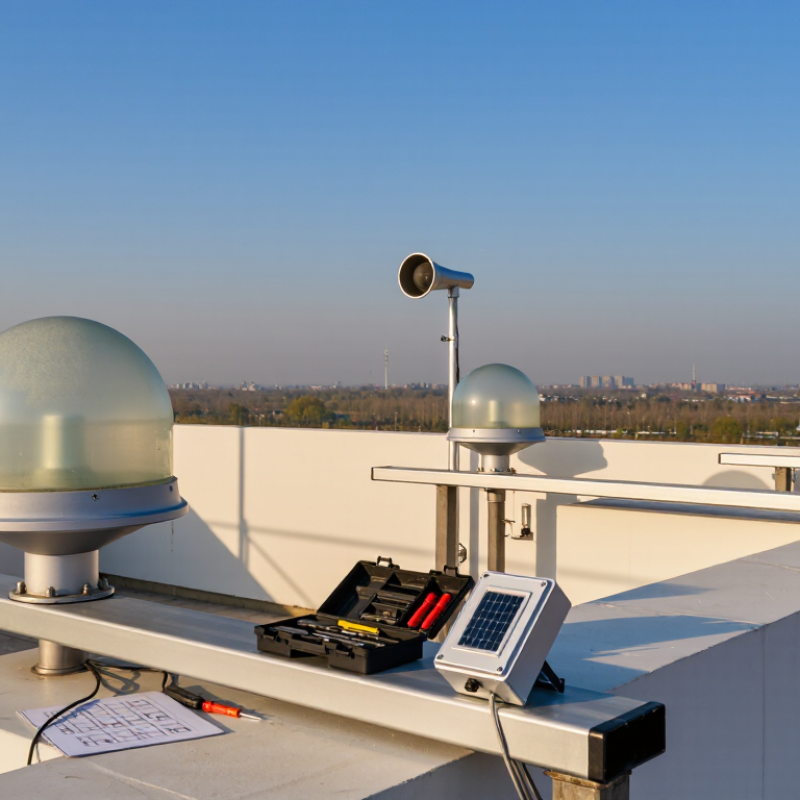
Choosing the right solar radiation sensor can determine whether a solar study reflects reality or hides costly errors. A sensor may sit quietly on a rooftop, yet dust, shading, temperature, and leveling can alter every recorded value.
Dr. Jan Kleissl, a leading solar-energy researcher, writes, “The sun is the ultimate source of energy for almost all processes on Earth.” That energy must be measured carefully. Pyranometers, pyrheliometers, and reference cells each serve different purposes. Their accuracy depends on spectral response, cosine response, calibration, and installation quality.
Small details matter. A thin layer of dust can reduce readings. A nearby parapet can cast a short morning shadow. Even a loose mounting screw can change the sensor’s angle after strong wind.
No sensor is perfect.
This guide compares top solar radiation sensor options for research stations, photovoltaic plants, weather networks, and field testing. It considers measurement range, response time, maintenance needs, durability, and compliance with recognized standards such as ISO 9060 and WMO guidance.
Specifications alone can mislead. A premium instrument may perform poorly when operators neglect cleaning or calibration. A lower-cost model may be suitable for trend monitoring but unreliable for bankable energy assessments. That distinction deserves attention.
The discussion also recognizes practical uncertainty. Real sites are rarely clean, level, and obstruction-free. Therefore, the best solar radiation sensor is not always the most expensive one. It is the model that matches the application, environment, data requirements, and maintenance discipline.
What Solar Radiation Sensors Measure and Why Accuracy Matters
Top Solar Radiation Sensors for Accurate Measurement?
Solar radiation sensors measure irradiance, usually in watts per square meter. They capture sunlight striking a surface, not simply the brightness seen by the human eye. This distinction matters. A sensor can record strong visible light while missing changes in infrared radiation. Those differences affect photovoltaic testing, weather monitoring, crop studies, and building performance checks.
Accuracy matters because small measurement errors can distort energy forecasts and system evaluations. In field work, I have seen dust, moisture, and slight mounting angles create surprisingly different readings. A reliable sensor should offer stable calibration, suitable spectral response, and good cosine correction. Its data logger also needs consistent time settings. Otherwise, accurate measurements may still produce confusing comparisons. No sensor is perfect. Even careful testing can reveal assumptions that seemed reasonable indoors.
Tips: Mount the sensor level and keep its view unobstructed. Clean the sensing surface on a regular schedule. Compare readings with a calibrated reference during important studies. Record weather conditions, shading, cleaning times, and calibration dates. Watch for sudden jumps or flat lines. They may indicate wiring, condensation, or data-setting problems. Choose a sensor for the actual application, because laboratory precision does not always equal dependable outdoor performance.
Top Solar Radiation Sensors for Accurate Measurement? – What Solar Radiation Sensors Measure and Why Accuracy Matters
| Sensor Type | What It Measures | Typical Spectral Range | Typical Measurement Range | Typical Accuracy or Uncertainty | Common Applications | Why Accuracy Matters |
|---|---|---|---|---|---|---|
| Pyranometer | Global hemispherical solar irradiance, including direct and diffuse radiation on a horizontal or tilted plane | Approximately 285–2,800 nm for broadband instruments | 0–2,000 W/m² is commonly sufficient for surface measurements | High-quality reference instruments may achieve approximately 2–5% daily uncertainty when correctly installed and maintained | Solar resource assessment, photovoltaic performance monitoring, meteorological stations, building research | Small calibration and cosine-response errors can significantly affect energy-yield estimates and system-performance ratios |
| Pyrheliometer | Direct normal irradiance from the solar disc, usually with a tracking system | Approximately 200–4,000 nm, depending on instrument design | 0–1,500 W/m² is typical for direct-beam solar measurements | Approximately 1–3% daily uncertainty is achievable with a well-maintained, high-performance system | Concentrating solar power studies, atmospheric research, solar forecasting, direct-resource mapping | Tracking alignment, sensor response, and atmospheric effects directly influence estimates of usable direct solar energy |
| Albedometer | Incoming shortwave irradiance and reflected shortwave irradiance; albedo is calculated as reflected divided by incoming irradiance | Approximately 285–2,800 nm for broadband shortwave sensors | Typically 0–2,000 W/m² per measurement direction | Albedo uncertainty is commonly around 3–10%, depending on surface brightness, installation, and sensor matching | Snow and ice studies, land-surface research, climate monitoring, agricultural and ecological measurements | Errors in either upward or downward flux can distort surface-energy-balance and climate calculations |
| PAR Sensor | Photosynthetically active radiation used by plants for photosynthesis, reported as photosynthetic photon flux density | 400–700 nm | Approximately 0–3,000 µmol/m²/s for many outdoor and controlled-environment applications | Often about ±5% to ±10%, depending on calibration, spectrum, temperature, and angle of incidence | Greenhouses, crop science, plant physiology, vertical farming, ecological monitoring | Accurate light-dose data supports reliable irrigation, lighting control, growth modeling, and crop-comparison results |
| UV Radiometer | Ultraviolet irradiance or dose in a defined UV band, such as UVA or UVB | Commonly 280–400 nm, with band-specific models available | Usually selected for low-to-moderate UV levels; range depends strongly on the detector and filter | Approximately ±5% to ±15% is common for field instruments, depending on wavelength and calibration | UV exposure studies, materials testing, environmental monitoring, photobiology | Spectral selectivity and calibration are essential because UV levels can be small but biologically and materially significant |
| Net Radiometer | Net radiation: downward minus upward shortwave and longwave radiation | Combined shortwave and longwave coverage, often about 0.3–100 µm | Commonly approximately −1,000 to +1,000 W/m², depending on local conditions | Often around ±5% to ±10% for complete net-radiation measurements | Evapotranspiration studies, hydrology, micrometeorology, ecosystem and climate research | Reliable net-radiation values improve energy-balance closure and water-use calculations |
| Sunshine Duration Sensor | Time during which direct solar irradiance exceeds a defined threshold, traditionally based on about 120 W/m² | Broadband or spectrally filtered response, depending on sensor technology | Time output, generally recorded in minutes or hours per day | Accuracy depends on threshold stability, cloud conditions, temperature, and classification method | Weather services, climate records, agricultural planning, solar-resource screening | Consistent threshold behavior is necessary for comparing sunshine records across locations and years |
Related Posts
-
Top 10 Solar Radiation Sensors You Should Know About?
-

Understanding Pyranometers and Their Role in Solar Radiation Measurement
-
Top 10 Solar Radiation Sensors for Accurate Measurements?
-
Top 10 Temperature Probe Sensors for Accurate Cooking and Baking
-
Top 5 Tips for Choosing a Solar Irradiance Sensor?
-
2026 Best Temperature Probe Sensor What to Look For?