









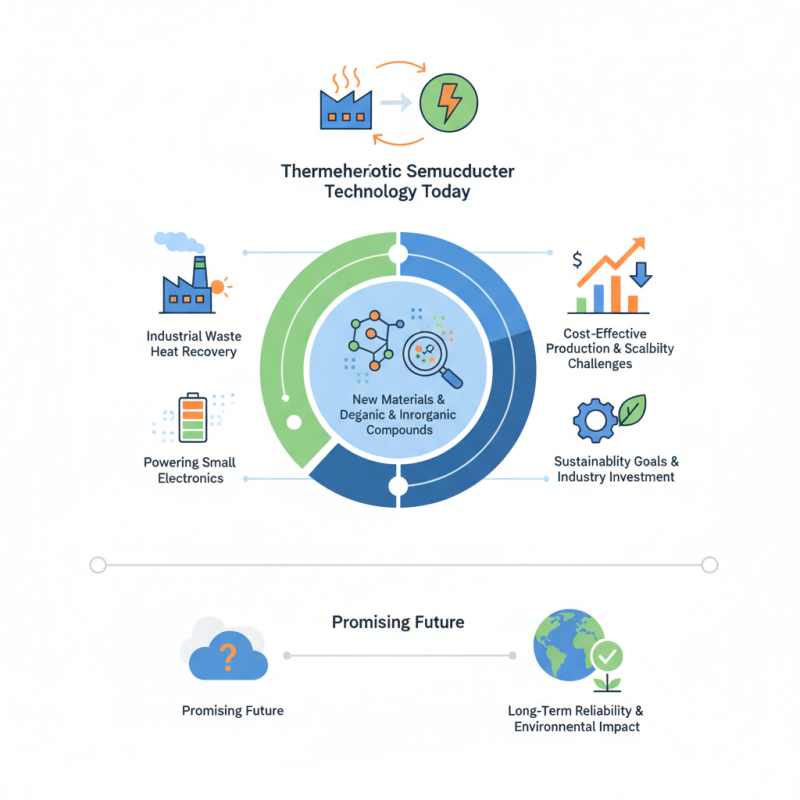
In recent years, Thermoelectric Semiconductors have gained significant attention in various applications. These materials convert heat directly into electricity, offering innovative solutions for energy efficiency. Their potential extends from industrial waste heat recovery to powering small electronic devices.
Research into Thermoelectric Semiconductor technology is evolving rapidly. Scientists are exploring new materials and designs to enhance performance. This includes advancements in organic and inorganic compounds. These new approaches aim to improve the efficiency of energy conversion. However, challenges persist in achieving cost-effective production and scalability.
The future of Thermoelectric Semiconductors is promising yet uncertain. With growing interest, the market is expected to expand. Various industries are investing in this technology to meet sustainability goals. Nonetheless, questions remain about long-term reliability and environmental impact. Addressing these concerns is essential for broader adoption.
The current state of thermoelectric semiconductor technology is rapidly evolving. Recent reports highlight that the global thermoelectric market is projected to reach $900 million by 2026, growing at a CAGR of over 6%. This increase is driven by advancements in materials and manufacturing processes. Researchers are focusing on high-performance materials like bismuth telluride and skutterudites that can operate efficiently in various temperatures.
Tip: Keep an eye on emerging materials. They can significantly enhance power conversion efficiency.
Thermoelectric semiconductors convert heat to electricity, providing sustainable solutions. For instance, waste heat recovery is a critical application. Industries can reduce energy costs while decreasing emissions. However, the technology faces challenges, like low efficiency in converting heat compared to traditional energy sources. Continuous research is vital to improve these systems.
Tip: Invest time in understanding current efficiency metrics. Familiarize yourself with performance limits and breakthrough materials. This knowledge is essential for making informed technology decisions.
| Trend | Description | Applications | Materials Used |
|---|---|---|---|
| Enhanced Efficiency | Focus on improving the conversion efficiency of thermoelectric materials. | Power generation from waste heat, cooling applications. | Bismuth telluride, lead telluride. |
| Flexible Thermoelectrics | Development of flexible thermoelectric materials for wearable technology. | Wearable devices, portable electronics. | Organic semiconductors, nanowires. |
| Nanostructured Materials | Utilization of nanotechnology to improve thermoelectric performance. | Thermal management systems, refrigeration. | Quantum dots, nanotubes. |
| Integration with Renewable Energy | Coupling thermoelectrics with solar power systems for enhanced efficiency. | Solar thermal energy conversion, hybrid systems. | High-performance ceramics, efficient metals. |
| Waste Heat Recovery | Technologies aimed at harvesting waste heat from various industries. | Industrial processes, automotive applications. | Silicon, half-Heusler alloys. |
Thermoelectric semiconductor technology is advancing rapidly. The focus is on key materials that enhance efficiency. Recent studies indicate that materials like bismuth telluride and skutterudites are critical. These materials show promising thermoelectric performance. They convert waste heat into usable electricity effectively.
According to a market research report, the global thermoelectric materials market is projected to reach USD 1.68 billion by 2027, growing at a CAGR of 9.6%. This growth underscores the increasing interest in thermoelectric applications. However, challenges remain. The high cost of material synthesis and efficiency at room temperature are ongoing concerns. Researchers are exploring alternative compounds, such as half-Heusler alloys, which could lower production costs.
Moreover, nanostructuring techniques are being employed to improve performance. These advancements could enable more widespread adoption in industries ranging from automotive to aerospace. Still, the need for more reliable data on long-term stability persists. Continuous research is essential to overcome these hurdles and achieve practical, efficient thermoelectric solutions.
Recent innovations in thermoelectric devices are reshaping energy conversion methods. Researchers are exploring new materials like skutterudites and half-Heusler alloys. These materials show improved efficiency. They can convert waste heat into usable electricity more effectively.
Advancements in nanostructuring techniques also play a crucial role. Scientists are developing nanowires and quantum dots. These structures enhance thermoelectric performance by reducing thermal conductivity. However, scalability remains a challenge. Producing these structures in bulk for commercial use is still complex.
Furthermore, there is a growing focus on sustainable materials. For example, organic thermoelectric materials are emerging. They offer flexibility and lower production costs. Yet, their performance still lags behind traditional materials. This highlights the need for ongoing research and development. Scientists must continue to address efficiency and scalability.
Thermoelectric technology is revolutionizing various industries. Its ability to convert heat into electricity opens up new opportunities. In manufacturing, these semiconductors improve energy efficiency. They help in waste heat recovery. This process not only saves energy but also reduces costs.
In automotive applications, thermoelectric generators are gaining traction. They can harness the heat from engines, improving overall fuel efficiency. This means less fuel consumption and reduced emissions. In electronics, thermoelectric coolers provide precise temperature control. They offer a silent operation, crucial for sensitive equipment. However, the efficiency of these devices needs further improvement.
Moreover, challenges remain. The materials used can be costly and not always sustainable. Researchers are exploring alternative, less expensive options. There is a need for collaboration between academia and industry. This can foster innovation and address existing limitations. The future of thermoelectric technology looks promising, but much remains to be done.
Thermoelectric semiconductor technology faces several challenges today. One significant issue is the low efficiency of current materials. According to a report by the U.S. Department of Energy, most commercial thermoelectric materials have a figure of merit (ZT) below 1. This limits their practical applications in energy harvesting and waste heat recovery. Researchers are exploring new materials, such as skutterudites and half-Heusler alloys, to enhance performance.
Another challenge involves manufacturing methods. Creating high-quality thermoelectric materials requires precise control over composition and structure. Techniques like additive manufacturing show promise but are still in the experimental phase. Studies indicate that scaling these techniques for mass production could significantly reduce costs and improve accessibility.
Future directions in thermoelectric research must address these hurdles. Efforts are focusing on nanostructuring techniques to increase ZT values. Additionally, integrating machine learning into materials discovery could accelerate the identification of effective compounds. As the demand for sustainable energy solutions grows, overcoming these challenges will be critical in advancing thermoelectric technology.