






What Is Thermal Conductivity of Materials?

Thermal conductivity of materials determines how quickly heat moves through a solid, liquid, or engineered interface. It shapes battery safety, building efficiency, semiconductor cooling, and industrial equipment reliability. A copper heat spreader feels rapidly warm because its electrons transport energy efficiently. Glass behaves differently, creating a slower thermal path.

The U.S. National Institute of Standards and Technology (NIST) identifies thermal conductivity measurement as highly dependent on temperature, specimen geometry, surface condition, and test method. ASTM C177 and ASTM C518 therefore provide different approaches for evaluating insulation performance. These details matter. A reported value without test conditions can mislead engineers.

Industry evidence shows why this topic deserves closer attention. The International Energy Agency reports that buildings account for roughly 30% of global energy demand, making insulation and heat transfer central efficiency concerns. The U.S. Department of Energy also highlights advanced materials and thermal management as priorities for reducing energy loss in buildings, vehicles, and electronics.

French physicist Joseph Fourier established the foundation of heat conduction theory. In The Analytical Theory of Heat (1822), he wrote, “The propagation of heat in solid bodies depends on the distribution of temperatures.” His insight still guides modern material design.

Yet thermal conductivity is not a single, perfect number. Manufacturing defects, moisture, pressure, and aging can change performance. Even familiar materials vary between laboratory data and factory conditions. That gap deserves honest attention. This guide examines measurement methods, material classes, practical applications, and the limitations engineers must consider before selecting a thermal solution.
What Is Thermal Conductivity of Materials?

What Thermal Conductivity Means

Thermal conductivity describes how readily heat travels through a material. It is not a measure of heat itself. A high-conductivity material passes thermal energy quickly, while a low-conductivity material slows that movement. The standard unit is watts per meter-kelvin, written as W/(m·K). In simple terms, the value shows how much heat crosses a material when temperature differs across its thickness.

Heat moves. That distinction matters.

A metal spoon may feel cold because it draws heat from your hand efficiently, not because its temperature is necessarily lower. In building tests, insulation often performs better when it contains still air. However, moisture can fill those air spaces and increase heat transfer. Small details change the result.

A conductivity value usually comes from controlled laboratory conditions. Real performance can differ because of density, temperature, moisture, pressure, and surface contact. For example, two panels made from similar ingredients may transfer heat differently after compression. Engineers often use Fourier’s law to estimate heat flow, but the calculation depends on reliable measurements and accurate thickness data. I have found that simple comparisons can mislead when contact resistance is ignored. Even a thin gap may matter. Measurements need context, and published figures deserve careful checking rather than blind acceptance.

How Heat Moves Through Different Materials

What Is Thermal Conductivity of Materials?

Thermal conductivity describes how easily heat moves through a material. Heat travels from hotter regions toward cooler ones. High-conductivity materials transfer energy quickly. Metals usually behave this way because their mobile electrons carry energy through the solid. A metal spoon can feel cold in a warm kitchen because it draws heat from your hand efficiently.

Low-conductivity materials slow this movement. Wood, rubber, and trapped air resist heat transfer because their structures limit energy flow. A wooden handle stays more comfortable near a hot pan than a metal handle. However, “insulating” does not mean completely heatproof. Thin wood can warm quickly, and compressed air may conduct more heat than expected. Small details matter.

Engineers measure conductivity in watts per meter-kelvin. They consider temperature difference, material thickness, surface area, and contact quality. A thicker layer usually slows heat movement, while a larger area allows more heat to pass. Moisture can change results, especially in soil, wood, and building materials. A simple test with temperature sensors may reveal uneven heating across a sample. That result can be useful, but it is not perfect. Sensors may touch poorly, and surrounding air can disturb the measurement. Material structure also matters: dense crystal, loose fibers, and tiny gaps move heat differently.

What Is Thermal Conductivity of Materials? - How Heat Moves Through Different Materials

Typical thermal conductivity values at approximately room temperature

Material Material Type Thermal Conductivity
(W/m·K)
Relative Heat Transfer How Heat Moves Through It Typical Applications or Notes
Diamond Crystalline solid 1,000–2,200 Extremely high Vibrational energy travels rapidly through a rigid crystal lattice. Excellent heat-spreading material; conductivity varies with crystal quality and direction.
Silver Metal 429 Extremely high Free electrons carry thermal energy efficiently. Very high conductivity, although cost and softness limit widespread use.
Copper Metal 398–401 Extremely high Electron movement transfers heat quickly through the metal. Commonly used for heat exchangers, cookware, and thermal conductors.
Gold Metal 315–320 Very high Mobile electrons transport energy through the metallic structure. Highly conductive and corrosion-resistant, but expensive.
Aluminum Metal 205–237 Very high Electrons transfer heat efficiently through the lightweight metal. Widely used in radiators, heat sinks, cookware, and building components.
Brass Metal alloy 100–125 High Electron transport is reduced compared with pure copper. Conductivity depends on the copper and zinc content of the alloy.
Iron Metal 73–80 High Both electrons and lattice vibrations contribute to heat transfer. Conductivity changes with purity, temperature, and microstructure.
Carbon steel Metal alloy 43–60 Moderate Metallic conduction is affected by carbon content and alloy structure. Common structural metal; generally conducts less heat than pure iron.
Glass Amorphous solid 0.8–1.4 Low Heat moves mainly through atomic vibrations, which are scattered in the disordered structure. Thermal conductivity varies with composition, porosity, and temperature.
Concrete Composite building material 1.0–2.5 Low to moderate Heat passes through cement paste, aggregates, pores, and moisture. Moisture, density, aggregate type, and porosity strongly affect conductivity.
Brick Ceramic building material 0.6–1.0 Low Heat travels through the mineral matrix and trapped air in pores. Denser and wetter bricks usually conduct heat more effectively.
Water Liquid 0.58 Low Molecular interactions conduct heat, while fluid motion can also transfer energy by convection. The listed value describes conduction; convection may dominate in moving water.
Dry wood Natural porous solid 0.12–0.20 Very low Heat moves slowly through wood fibers and the air-filled pores between them. Moisture, grain direction, density, and species affect conductivity.
Mineral wool Fibrous insulation 0.035–0.045 Extremely low Fine fibers restrict solid conduction and trap many small pockets of air. Performance depends on density, moisture, orientation, and temperature.
Polystyrene foam Polymeric insulation 0.029–0.040 Extremely low Cell walls and trapped gas greatly limit conduction and air movement. Closed-cell and expanded forms have different structures and conductivity values.
Air Gas 0.025–0.026 Extremely low Widely spaced molecules transfer relatively little heat by conduction. Still air is a useful insulator; movement can increase heat transfer through convection.

Note: Thermal conductivity describes how readily heat passes through a material by conduction. Values are typical approximate figures near room temperature and may change with temperature, moisture, density, purity, composition, direction, and manufacturing method. A lower value generally indicates better resistance to conductive heat flow.

Factors That Influence Thermal Conductivity

What Is Thermal Conductivity of Materials?

Factors That Influence Thermal Conductivity

Thermal conductivity describes how quickly heat moves through a material. A metal spoon warms faster than a wooden handle because its structure transfers energy efficiently. Yet conductivity is not fixed in every situation. Temperature, moisture, density, and direction can change measured performance. In practical testing, I would record conditions carefully, because one value can create false confidence.

Material composition strongly influences heat flow. Free electrons help many metals conduct heat, while trapped air makes foam effective insulation. Direction matters too. Crystalline materials may conduct better along an organized lattice than across it. This directional behavior is called anisotropy. Defects, pores, and impurities interrupt moving energy and usually lower conductivity. Some engineered structures use these interruptions deliberately.

Moisture complicates matters. Water can replace air inside insulation and increase heat transfer. As temperature rises, conductivity may shift, especially in polymers, gases, and porous materials. Thickness affects real assemblies, but it does not change intrinsic conductivity. Contact pressure and surface roughness influence resistance between joined parts. Laboratory results can look precise yet fail in field conditions. Installation gaps, dust, aging, and uneven pressure are easy to underestimate. Even careful measurements deserve another look.

How Thermal Conductivity Is Measured

Thermal conductivity describes how quickly heat moves through a material. Measuring it is less simple than reading a single number. The result depends on temperature, moisture, density, thickness, and contact pressure. A dry ceramic tile can perform differently from the same tile after water enters its pores.

A guarded hot plate follows ASTM C177. It places a flat specimen between a hot plate and a cold plate, then measures steady heat flow. The equation is simple: conductivity equals heat flow multiplied by thickness, divided by area and temperature difference. It sounds clean. Real tests are messier. Edge losses, air gaps, and uneven surfaces can distort results. ASTM C177 is commonly selected for insulation and low-conductivity materials because it controls these effects carefully.

A heat flow meter, described by ASTM C518, usually measures faster. It estimates conductivity from heat passing through a calibrated sensor and the specimen. ISO 22007-2 covers transient methods, which can test smaller samples and reduce waiting time. However, faster does not always mean better. NIST measurement guidance emphasizes calibration, traceability, and uncertainty reporting. Professional laboratories often report uncertainty near several percent, depending on the method and sample.

I would record temperature and moisture with every result. Otherwise, the number lacks context. A measurement may look precise while describing only one narrow condition. That is an easy mistake, even in experienced testing work.

What Is Thermal Conductivity of Materials?

Thermal conductivity describes how effectively a material transfers heat. The chart compares approximate values at 25°C, measured in watts per meter-kelvin (W/m·K).

Thermal conductivity is commonly determined by applying a known temperature difference across a test specimen and measuring the steady heat flow through it. Using the relationship k = QL/(AΔT), where k is thermal conductivity, Q is heat-transfer rate, L is specimen thickness, A is cross-sectional area, and ΔT is the temperature difference. Actual values can vary with temperature, moisture, density, and material structure.

Comparing Conductive, Insulating, and Composite Materials

What Is Thermal Conductivity of Materials?

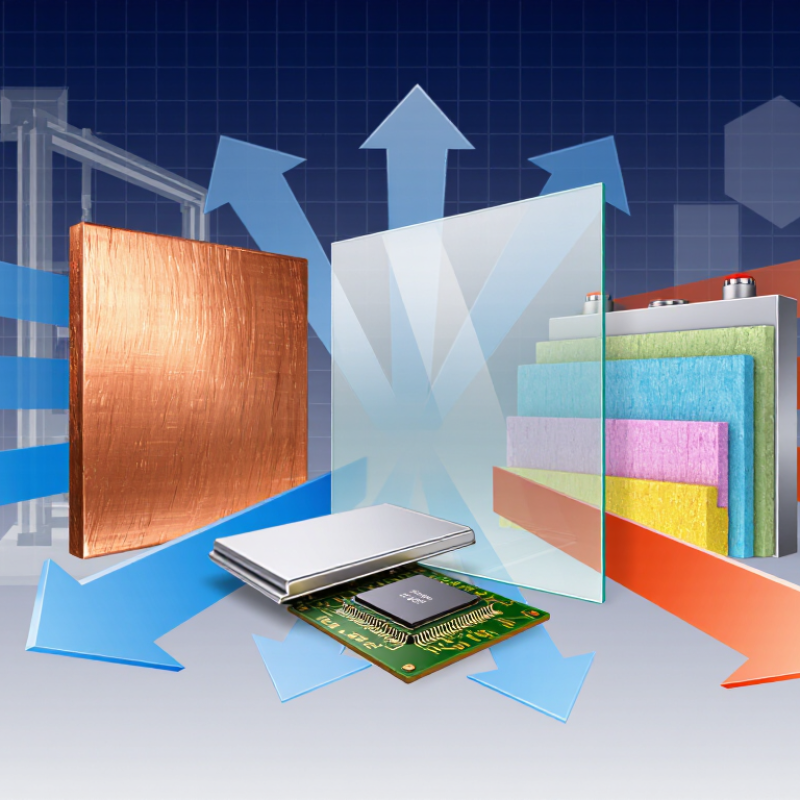
Thermal conductivity describes how easily heat travels through a material. It is measured in watts per meter-kelvin (W/m·K). A copper sheet transfers heat quickly because its mobile electrons carry energy efficiently. This makes conductive materials useful in heat exchangers, cookware, and electronic cooling systems. However, high conductivity can become a problem when a surface must remain comfortable to touch.

Insulating materials behave differently. Their tiny air pockets interrupt heat movement and slow temperature changes. Mineral wool, foam, wood, and glass generally conduct heat poorly. A thick, dry layer can protect a warm pipe or keep indoor heat from escaping. Moisture changes the result. Wet insulation often performs worse because water conducts more heat than trapped air. Small gaps matter too.

Composite materials combine contrasting properties. A polymer filled with ceramic particles may conduct heat better than plain polymer while remaining lightweight and electrically safe. Layered panels can place a strong conductor beside an effective insulator. The interface is critical. Poor contact creates thermal resistance, even when each material performs well alone. In practical testing, results may differ from handbook values because pressure, thickness, orientation, and surface condition affect heat flow.

Measurements are not perfect. That deserves attention.